



Taiwanese & Japanese Home Movies: Small Film, Vast Universe
|
|
Up to a certain point in the 20th century there were no video cameras, and of course no smart phones. People used small-gauge film to document their everyday lives. What happens when films that people have kept carefully stored in their homes over the years are taken out and threaded onto a projector? They turn out to be time capsules, bringing back family memories, local customs, and pages from history!
These home movies are amateur films made by people using smallgauge film formats, like 8mm, 9.5mm, or 16mm, to capture scenes from their households and their everyday lives. We present footage that lovingly documents family life in Taiwan and Japan from the 1930s through the 1960s, revealing the hidden power of the home movie as a communication tool to connect people across times and places.
Taiwanese Home Movies
- Live commentary by Su Ui-tiok with Q&A
- Moderator: Dai Zhoujie (Faculty of Kansei Design, Hachinohe Institute of Technology)
8mm Film by Dr. Ting Ray-yü
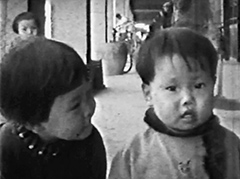 TAIWAN / 1940–1943 / Silent / B&W / Digital File (Original: 8 mm) / 26 min
These home movies shot by a doctor in Lulang, a town south of Taipei, before World War II vividly reflect the reality of colonial rule—from footage of Japanese military personnel and indigenous Takasago youth in soldier’s uniforms—to views of a parade celebrating the Tripartite Pact and Taiwanese children wearing Japanese kimono and loincloths. The doctor also trains his camera on his family’s smiling faces. Eventually, a draft notice arrives, and the family offers prayers at a shrine.
8mm Film by Photographer Hsu Tsang-tse
- TAIWAN / 1964 / Silent / B&W, Color / Digital File (Original: 8mm) / 20 min
This footage is of a family trip to Taitung and Tainan by taxi in the 1960s. During the Japanese colonial era, only Japanese officials were permitted to visit the Taroko area, home to several indigenous Taiwanese populations, and entry by other Taiwanese citizens was difficult. Following the screening, researcher Su Ui-tiok will discuss these rare color images along with the shadow of Japanese colonial rule looming over the happy moments of family life that they portray.
Japanese Home Movies
16mm Film by Sato Kyukichi
- JAPAN / 1938–1939 / Silent / B&W / Digital File (Original: 16mm) / 20 min
This footage was shot by the head of a sake brewing company located in Yamagata Prefecture’s Sakata City, known for its Hatsumago sake. It depicts the members of his family as well as a local matsuri (festival) and captures in detail home life in Japan before the war. It also offers a glimpse of the former Green House theater, a cinema that was lost to the community when it burned down.
8mm Film by Masuya Jiro
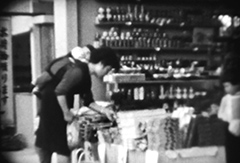
- Live commentary by Masuya Shuichi with Q&A
JAPAN / 1959–1967 / Silent / B&W, Color / 8mm / 27 min
The late Masuya Jiro, former proprietor of the Masuya Clock Shop located in Yamagata City, purchased an 8mm movie camera on the occasion of his son’s birth and documented his family life. The resulting footage is filled with scenes that will be familiar to residents of Yamagata, from mountain temples and imoni (taro stew) parties to views of alleyways, snow clearing, and the fountain in front of the Prefectural Hall.
Footage Connecting Japan and Taiwan
Return: Yamagata × Hualien 1960s
- TAIWAN, JAPAN / 2024 / No Dialogue / B&W, Color / Digital File (Yamagata Segment: 16mm Original, Hualien Segment: 35 mm Original) / 43 min
Music: Lim Giong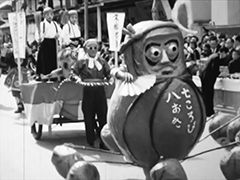
Message from Four Seasons
Sound Design: Jerry Hsu
Editing, Post-Production: Chang Chih-hung, ReSound Music Group
In Cooperation with Listen to Tell Studio Co., Ltd. (Hualien Railway Cinema), Hualien County Cultural Affairs Bureau, Taiwan Film & Audiovisual Institute
This program features footage from Yamagata City PR films Message from Four Seasons, produced 1950-1960, and newsreels of Hualien in the 1960s, archived by the Taiwan Film & Audiovisual Institute (TFAI). It was screened with live music accompaniment as part of the International Documentary Film Festival Exchange (Live Cinema) program held in Hualien, Taiwan in November 2024. The YIDFF version will use a recording of the music that was performed live on that occasion.