



Juror
Azza El-Hassan

[Juror’s Statement]
There are places that never leave you and YIDFF is one of these places. The first time I came here was 2001 and I was immediately smitten by the atmosphere, the cinema culture in this festival and the audience here. I met people who became lifelong friends and watched films that changed how I later on made my own films. Twenty-four years later, I am now very much looking forward to being part of this year’s festival and to watch the selected films which I am sure will not only offer me, as a spectator, a spectacular experience of watching, but will also challenge me and provoke in me new thoughts and ideas that will expand my boundaries and vision.
Filmmaker and professor of media practices at the Doha Institute for Graduate Studies. She is the recipient of the BAFTSS Outstanding Achievement Award, 2025. She is also the winner of various international film awards, such as the Ortensia d’Argento-Sensibilità Mediterranea Luchino Visconti Award, the Al Jazeera Jury Award and the Grierson Award, among others. She is known for News Time (2001, YIDFF 2001), Kings & Extras (2004) and The Unbearable Presence of Asmahan (2014, YIDFF 2015). In 2018, El-Hassan founded The Void Project, a multimedia production platform that puts to use photos and films that survive violence.
Kings and Extras
ملوك وكومبارس- PALESTINE, GERMANY, FRANCE, UK / 2004 / Arabic, English / Color / 62 min
 Director, Script: Azza El-Hassan
Photography: Pascale Granel
Editing: Gladys Joujou
Sound: Moncef Taleb, Hanna Abu Seh’deh, Ibrahim Shishani
Sound Design: Sven Piesker
Production Companies: Ma.Ja.De Filmproduktion, Yamama Creative House
Source: Azza El-Hassan
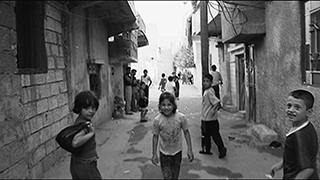
Films made by the film unit of the Palestine Liberation Organization (PLO) were seized by the Israeli army during its 1982 invasion of Beirut, Lebanon. While employing a traditional documentary style involving numerous interviews with key figures who hold clues to the films’ whereabouts, this is a superb road movie that reveals the absurd reality faced by the Palestinian people through its skillful narrative, the dialogue between the director and the subjects captured by the camera, and the landscapes shown within the frame.