



What Did You Dream Last Night, Parajanov?
Was hast du gestern geträumt, Parajanov?؟دیشب چه خو ابی دیدی پار اجانف
- GERMANY / 2024 / Farsi / Color / DCP / 81 min
 Director, Script, Photography, Editing: Faraz Fesharaki
Photography: Moritz Friese, Shahab Fotouhi
Sound Mixing: Jan Pasemann
Sound Design: Sum-Sum Shen
Producers: Luise Hauschild, Ewelina Rosinska, Mariam Shatberashvili
World Sales: Oyster Films, Christina Demetriou
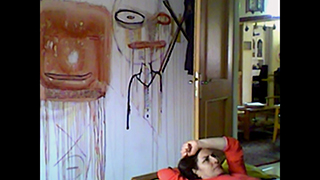
The filmmaker, based in Berlin, recorded mundane online conversations with his parents far away in Isfahan and his cousin in Vienna over a period of 10 years. Possibly due to poor connectivity, the conversations with his parents are riddled with noise, but between bits of small talk, his father’s poetry readings, his mother’s recollections of her time in prison, and his parents’ words of longing for their distant child slip in. Meanwhile, with his cousin of the same generation—who calls him “Parajanov”—he shares a series of lighthearted, humorous conversations. These two irreplaceable periods of time for the filmmaker gradually intertwine in the film. (OR)
[Director’s Statement] My mother once asked why I was recording our Skype conversations. This was in 2012, a few months after I had moved to Germany. I told her the recordings were like diaries, that I was too lazy to write them down, and even if I did, I could never capture with words the beauty of those moments in such detail, so precisely and with such fidelity.
How could I describe watching my mother secretly, knitting a jumper in front of the webcam, waiting for me and humming a song to herself ? How could I put into words the moment my father asked if I liked him, and I couldn’t give a serious answer? I still don’t have the words to describe how it felt when my mother made me laugh with her stories from prison. Only a camera could record it.
“The camera doesn’t lie,” Abbas Kiarostami used to say in his workshop. “One can trust the camera.” That’s why I recorded those moments.
Now that the film is complete, I’m no longer sure. If the camera doesn’t lie, why did it allow me to leave the editing room each day with a new version of my family? That remains a mystery. I no longer recall which moments in the film truly happened and which were staged during the edit.
I never sought to make a faithful documentary about the “real” Fesharaki family. What interested me were the small narratives that emerge when people love each other. In this sense, the camera can be trusted after all, because everything it captured happened with love and longing and was full of hope.
 Faraz Fesharaki
Iranian-German filmmaker and award-winning cinematographer living in Berlin. While studying Dramatic Literature and Film Studies at the Tehran University of Art, he attended Abbas Kiarostami’s workshop and began making his own short films. In 2012, he started studying at the German Film and Television Academy in Berlin. His graduation film as a cinematographer, What Do We See When We Look at the Sky? (2021, Dir. Alexandre Koberidze), premiered in competition at the Berlin International Film Festival in 2021, where it was awarded with the FIPRESCI prize. For his work on the film he also received the award for Best Cinematography at the Sevilla Film Festival and a nomination for Best Cinematography at the German Film Critic Awards. He shot Sara Summa’s second feature Arthur & Diana (2021) which premiered at the Toronto International Film Festival in 2023 and Mónica Lima’s short film Natureza Humana (2023), that won the Ammodo Tiger Short Award at the International Film Festival Rotterdam. This is his first feature length film as a director.